Ticket scalping has industrialised.
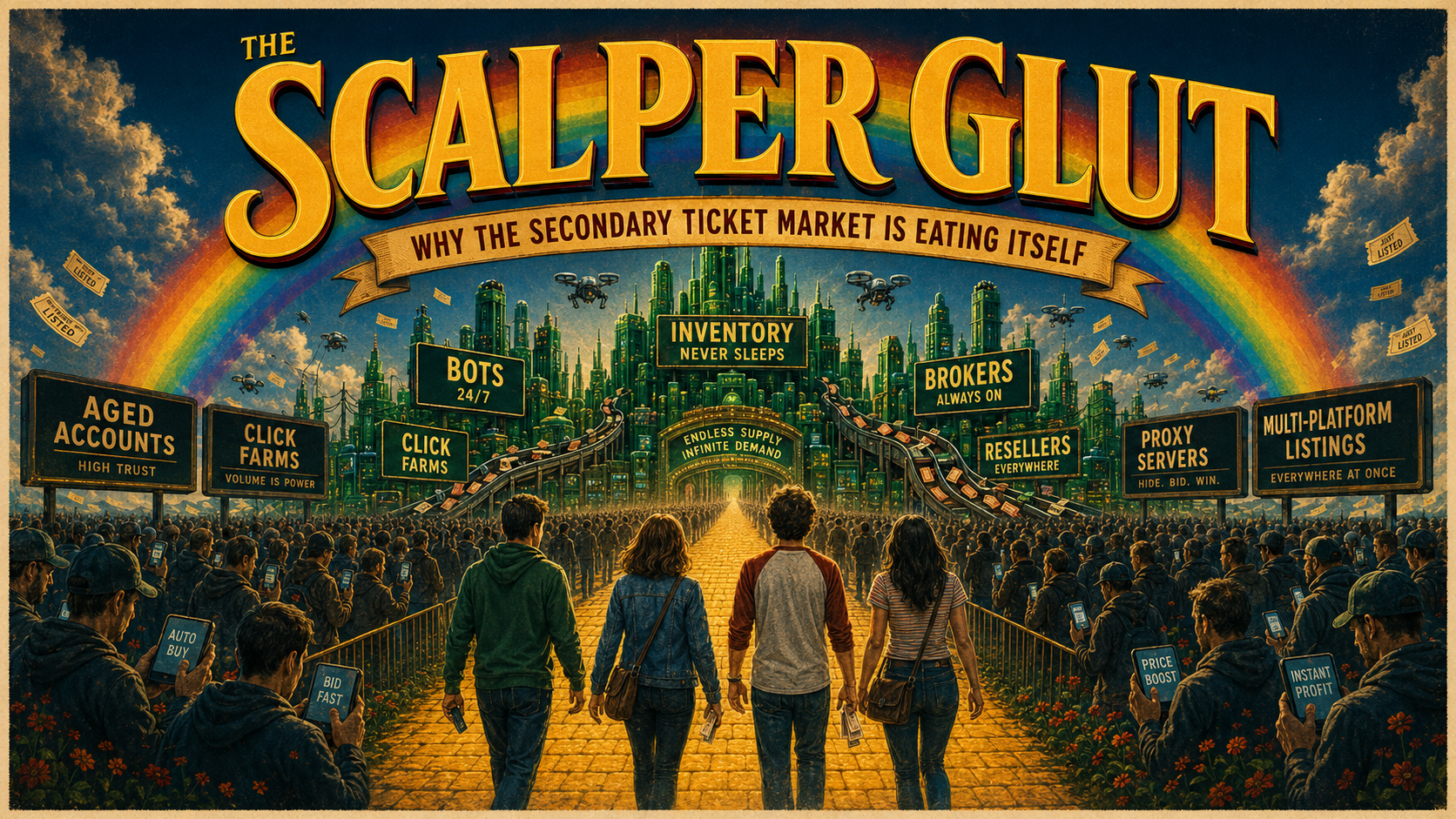
What used to require connections, cash, and long nights in queues can now be assembled in an afternoon. Bot services that buy faster than any human can click. Disposable identities built from virtual cards and temporary emails. Software that manages inventory across multiple resale platforms, syncs listings, and adjusts pricing automatically. Data tools and private communities that identify high-demand events before most buyers even know they exist.
The infrastructure is mature, widely accessible, and increasingly commoditised.
And that is where the problem starts. Not for fans, but for the scalpers themselves.
Too many operators, not enough scarcity
Scalping has always depended on one thing: scarcity. A sold-out event creates pressure. Demand spills into the secondary market. Prices rise. That is the model.
But the number of people now trying to extract value from that dynamic has grown far faster than the supply of genuinely scarce events. Where a major arena show once attracted a small number of experienced operators, it now draws hundreds, sometimes thousands, all targeting the same limited inventory.
More competition means fewer tickets per operator. Fewer tickets means thinner margins. And as margins compress, the system adjusts in the only direction it can: downward.
The downward push
The most sophisticated operators (fastest infrastructure, cleanest data, deepest networks) still dominate the highest-profile events. Major tours. Cup finals. Reunion shows. Those tickets still move at a significant premium.
But even at the top, competition has become intense enough that returns are declining. So attention shifts.
Mid-tier tours. Regional venues. Smaller artists. Events that might sell out, but might not. Inventory that carries real commercial risk.
What used to function as straightforward arbitrage increasingly resembles portfolio risk management. And for many operators, the economics are simply harder than they appeared from the outside.
There is a certain irony in it. A market built on exploiting scarcity has generated its own form of it: not scarcity of demand, but scarcity of profit. The tooling providers still get paid. The bot builders still get paid. The proxy services still get paid. The scalpers themselves are discovering that the market they entered no longer behaves the way it looked when they joined.
What this means for fans
From a fan perspective, the trajectory is not stabilising. It is expanding.
As more operators enter the market and margins compress at the top, activity pushes further into lower-tier events. More shows, across more levels of the industry, become exposed to resale pressure that was previously concentrated around headline events.
The structural shift is this: fans are no longer competing only with other fans.
They are competing with automated systems designed to move faster than any human. With coordinated purchasing networks. With outsourced acquisition operations running at scale. With infrastructure built specifically to capture inventory before it reaches a normal buyer's screen.
That changes the experience of buying tickets across the board, not just for the biggest shows, but increasingly for mid-size and emerging events too.
Why the system is starting to shift
None of this is permanent.
Rights holders, platforms, and regulators are beginning to address the problem on multiple fronts simultaneously: tighter platform controls, stronger identity verification, more coordinated enforcement, and legislation that is becoming more precise and more enforceable.
For a long time, these efforts moved slowly and independently. That is changing. The more significant development is that they are starting to converge: regulatory pressure, platform design, and enforcement moving in the same direction at the same time.
There is also a growing recognition that scalping is not simply a marketplace behaviour to be policed after the fact. It is a system design problem. The architecture of how tickets are sold, transferred, verified, and resold determines how much space exists for arbitrage, and how much can be structurally removed.
As that space narrows, the economics of industrial-scale scalping become less viable. Not because demand disappears, but because the infrastructure around ticketing is being redesigned to close the gaps that made it profitable in the first place.
That is a structural shift. And it is good news for fans.