
Ask anyone who runs a ticketing platform what they think about resale, and the same question comes up first: does it cannibalise primary sales? It is a fair question, and it deserves a precise answer rather than an assertion. It also turns out to be the wrong question to start with, because resale is not really a choice a platform makes. It is a structural consequence of selling tickets before every fan knows whether they can attend.
Economists and regulators have studied ticket resale for more than two decades, across concerts, sport, and different market structures, in the United States and the United Kingdom in particular. This article brings together a selected body of that research, the peer-reviewed studies, natural experiments and government reviews that carry the most weight, to set out what the evidence actually supports, where findings remain mixed, and what those conclusions may mean for a ticketing platform deciding how to handle resale today.
Every claim below is tied to its original source. Where a study was later published in peer review, the final published version is cited.
Scope: what this research covers, and what it does not
This is a selected body of peer-reviewed and government research, not a complete literature. It concentrates on four questions: market design, consumer welfare, primary-market effects, and regulation. Most of the empirical evidence comes from the United States and the United Kingdom, and from music and sport specifically, so findings should be read in the context of each study's market, period and method rather than treated as universal laws.
Three different research traditions run through this piece: market-design economics, empirical studies of specific markets, and regulatory and government reviews. They rarely cite each other directly, yet together they describe the same underlying exchange from three different vantage points, which is what makes the pattern in the second half of this article possible.
Three questions the evidence answers differently
Before going study by study, it is worth separating what this research actually settles from what it leaves open.
What the evidence consistently supports: a resale market can emerge naturally, because tickets are sold before final demand is known. Reallocating tickets to fans who value them more can create economic value. Unmanaged resale also introduces meaningful friction and rent-seeking. Market design materially affects who captures the value resale creates. And rules are harder to enforce once transactions move outside controlled channels.
What depends on market conditions: the effect of resale on organiser revenue, the effect of resale on consumer welfare overall, the optimal degree of pricing flexibility, and whether resale, refunds, or another reallocation mechanism performs best in a given market.
What the research does not establish: that resale always increases revenue, that resale always improves consumer outcomes, that one resale mechanism is optimal for every event or market, or that sponsored external marketplaces are equivalent to modern platform-native resale.
Why a resale market exists in the first place
The starting point for almost every paper in this field is a 2003 model by economist Pascal Courty that still holds up two decades later. His question was simple: even if a promoter prices tickets perfectly, with no intention of profiting from resale, does a secondary market still appear?
His answer is yes, and the reason is structural rather than accidental. Some fans know months in advance that they want to attend and are willing to commit early. Others only discover their real demand once their plans firm up close to the event. A promoter who wants to sell tickets at all has to sell to the early planners first, which opens a gap between the early sale and the event date. A broker, a season-ticket holder, or an ordinary fan whose plans changed can occupy that gap and sell into it later.
As Courty put it in the paper that started this line of research:
"Profit maximisation on the side of the promoter leaves profit opportunities for brokers. The promoter cannot capture the profits earned by brokers, and, moreover, cannot prevent brokers from entering the market."
Courty, P. (2003), Journal of Economic Perspectives
Whichever channel absorbs that reallocation, resale is likely to appear in some form. The question a platform can actually influence is whether that exchange happens inside its own environment, under its own rules, or in an external channel it cannot see. Resale is not a flaw introduced by any single actor. It is a predictable consequence of selling tickets before every fan knows whether they can attend.
Where the value in resale actually comes from
Phillip Leslie and Alan Sorensen's 2014 study is one of the most cited empirical papers in this field. Using matched Ticketmaster and eBay or StubHub records for 56 major rock concerts, they found that primary pricing was strikingly crude: most shows used only two to four price tiers regardless of venue size, and one Dave Matthews Band show sold all 24,873 seats at a single price.
That crude pricing left a gap, and the data shows it: the best seats were roughly four times more likely to be resold than mid-tier seats, evidence that underpricing concentrates at the top of the house, and the average markup across the dataset was 41% over face value, alongside a below-face share that shows not all resale is profit-driven.
Leslie and Sorensen also built an index comparing three scenarios: no resale at all, the resale market as observed, and a hypothetical frictionless resale market.

Indexed to the no-resale case (gross surplus = 100). Net surplus subtracts transaction, arrival and rent-seeking costs from gross surplus.
Reallocation raises gross surplus, by about 4% for observed resale and about 9% in a frictionless market, both against a no-resale baseline. But more than a third of that gross gain is absorbed by higher transaction and arrival costs and rent-seeking, so net surplus rises by only around 7% even in the frictionless case. In the same paper, fans who actually attend the event are frequently the biggest net losers from an unmanaged market, because they compete hardest, and pay the most in time and effort, for access to underpriced tickets.
The conclusion this study actually establishes: resale can improve allocation, but a meaningful share of the potential welfare gain is lost to transaction costs, queueing and rent-seeking. Whether the remaining value reaches fans depends on how the resale channel is structured. (Leslie, P. and Sorensen, A., 2014, Review of Economic Studies)
Resale is not the only way to reallocate a ticket
Drew Vollmer's model, built on a US college-football setting with comparatively little underpricing and few professional brokers, compares resale directly against refunds as two different ways to reallocate tickets once a fan's plans change. First published as a US Department of Justice discussion paper in 2022, the final peer-reviewed version appeared in the RAND Journal of Economics in 2025.
The finding is more nuanced than a blanket case for resale. Refunds were more efficient on average in the market studied, because resale carries frictions of its own: search costs, timing mismatches, and the risk a ticket goes unsold. Resale can outperform refunds after larger aggregate demand shocks, when flexible pricing lets the market clear an unusually large swing in demand.
No single reallocation mechanism wins in every setting. (Vollmer, D., 2025, RAND Journal of Economics, 56(3), 251 to 268)
Where the friction comes from: fees, arbitrage and bots
One figure recurs across nearly every paper and government report in this field: a fee taken by whoever intermediates the resale transaction. The figures below are not directly comparable to each other. They come from different markets, periods and fee structures, and use different denominators.
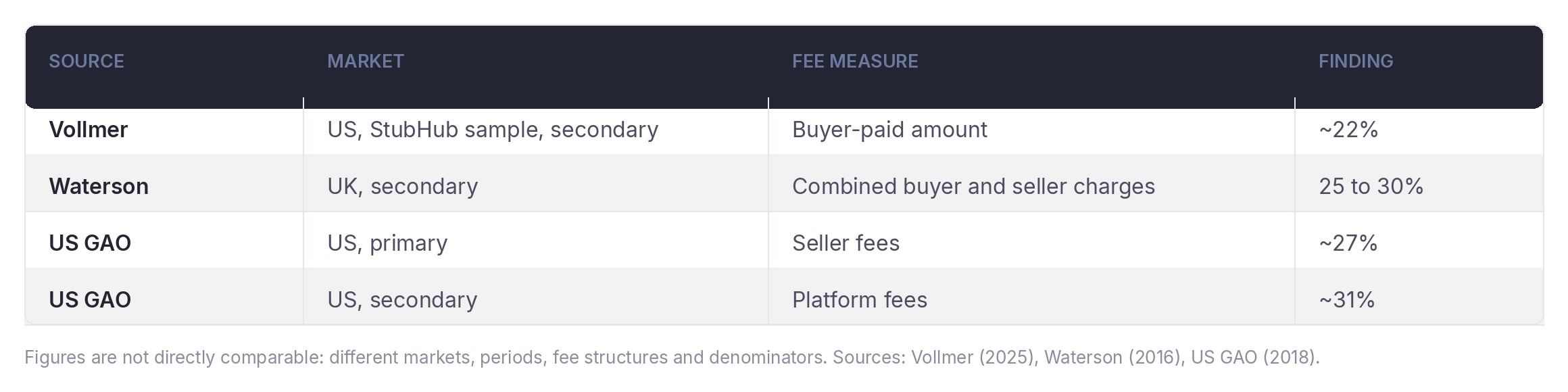
Across these studies, intermediating a resale transaction represents a meaningful share of transaction value, although fee structures and measurement methods vary significantly by platform and market. This is not evidence that every resale transaction loses a fixed quarter of its value to fees. (Vollmer, 2025; Waterson, 2016; US GAO, 2018)
Fees are only half the friction story. The other half is underpriced inventory creating an arbitrage that bots are built to capture. The logic runs in a straight line: primary tickets priced below what informed buyers will pay create a gap between face value and resale value that is visible and stable. Brokers organise to buy that gap at scale, and automation makes capturing it faster than any fan can react.
Eric Budish and Aditya Bhave studied Ticketmaster's own brief experiment with primary-market auctions: 759 auctions across 576 concerts on 22 tours between March 2007 and April 2008. Buying at face value and reselling earned an average return of 94%. That arbitrage nearly disappeared, down to around $6, once the primary auction priced the seat correctly in the first place. (Budish, E. and Bhave, A., 2023, American Economic Journal: Microeconomics)
The New York State Attorney General's 2016 investigation into ticket bots put numbers on how far that arbitrage gets pushed when automation enters the picture: one bot bought more than 1,000 U2 tickets in a single minute; the three largest bot operators bought more than 140,000 tickets over three years; a single bot operation reported more than $40 million in annual revenue; and markups reached more than 1,000% at the top, against an average closer to 50%. (New York State Attorney General, 2016)
Underpricing creates a prize, and bots and brokers organise around capturing it. Removing that prize, by pricing correctly or by managing the exchange, does more to change the outcome than banning any single actor from participating in it.
Does resale actually hurt primary ticket sales?
This is the objection every ticketing platform raises first, and it deserves a precise answer rather than an assertion. Three independent studies, using three different methods, reach three different conclusions.
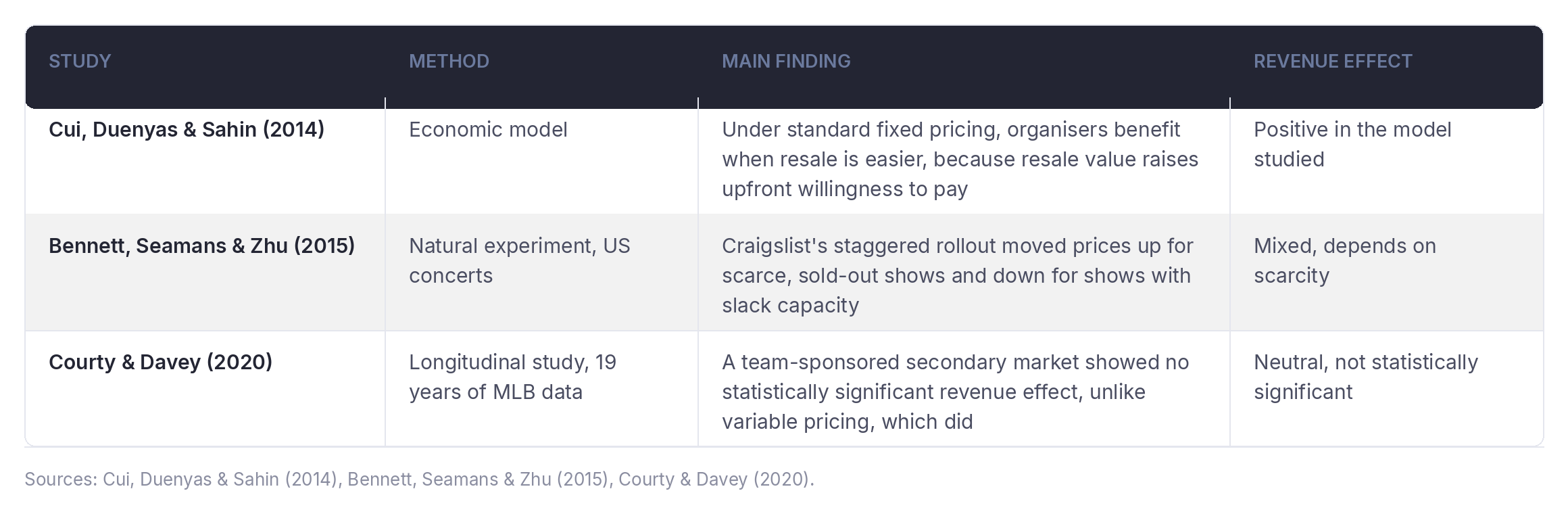
Sources: Cui, Duenyas & Sahin (2014) | Bennett, Seamans & Zhu (2015) | Courty & Davey (2020)
The MLB study is the least convenient result for anyone selling resale infrastructure, which is exactly why it belongs here. A team-sponsored secondary marketplace of that era, typically a partnership between a rights-holder and an independent external marketplace, provides a useful historical comparison for rights-holder participation in resale, although it is not equivalent to modern white-label, platform-native resale run inside the primary ticketing environment under organiser-defined rules.
Reading these three studies together, the research does not support treating resale as guaranteed incremental primary revenue. Its business case is broader than that: certified transfer, fraud reduction, data continuity, fan flexibility, reduced leakage to external channels, and, depending on market design, incremental revenue.
What two decades of regulation have actually achieved
Daniel Elfenbein studied eBay sales of NFL tickets across US states with different legal regimes between 2002 and 2005. Laws banning or capping resale above face value did not stop resale. They relocated it: online ticket supply fell by roughly 46% where resale above face value was banned outright, while cross-border transactions, fans and sellers routing around their own state's law by trading with someone in a neighbouring one, rose by 42 to 51% in the strictest states. It took about four seasons for prices in regulated states to converge back toward unregulated ones. (Elfenbein, D., 2006, working paper, Washington University in St. Louis)
Within four seasons, sellers in the strict states had learned the law was not, in practice, being enforced against them online, and behaviour reverted. The evidence shows that restrictions can be difficult to enforce when transactions migrate to channels outside the regulator's direct reach. Transaction-level infrastructure provides one way to apply eligibility, pricing and transfer rules automatically, rather than relying entirely on enforcement after the fact.
The United Kingdom: what is actually law, and what is still a proposal
The UK record spans more than a decade of escalating measures, and the milestones below are not all legally equivalent. Some are enacted and in force. One is a government policy commitment. One remains a draft bill. As of this article's publication, no cap on resale prices has been enacted into law.
- Consumer Rights Act, 2015 (IN FORCE). Mandatory disclosure of seat, face value and restrictions on resale listings.
- Bot Ban Legislated, 2017 (IN FORCE). Criminal ban on bot ticket-harvesting under the Digital Economy Act.
- DMCCA Direct Enforcement, 6 April 2025 (IN FORCE). The CMA gained direct consumer-enforcement power, usable against secondary-ticketing breaches, under the Digital Markets, Competition and Consumers Act 2024.
- Face-Value Cap Announced, November 2025 (GOVERNMENT COMMITMENT). The government's response to consultation confirmed an intention to cap resale at face value and limit resale volume, subject to legislation.
- Ticket Tout Ban Bill, May 2026 (PROPOSED). A draft bill was announced for pre-legislative scrutiny. Not yet enacted.
Sources: UK Government (2025), Response to the Consultation on the Resale of Live Events Tickets; The Digital Markets, Competition and Consumers Act 2024 (Commencement No. 2) Regulations 2025
The pattern across two decades and two countries is consistent: restrictions are harder to enforce once transactions move outside the channel the regulator or rights-holder can directly observe. That is a case for building enforcement into the transaction, not a claim that every rule fails.
What better market design actually looks like
No single paper in this body of research designs a modern resale platform. But read together, market-design models, natural experiments and government reviews point toward several recurring principles.
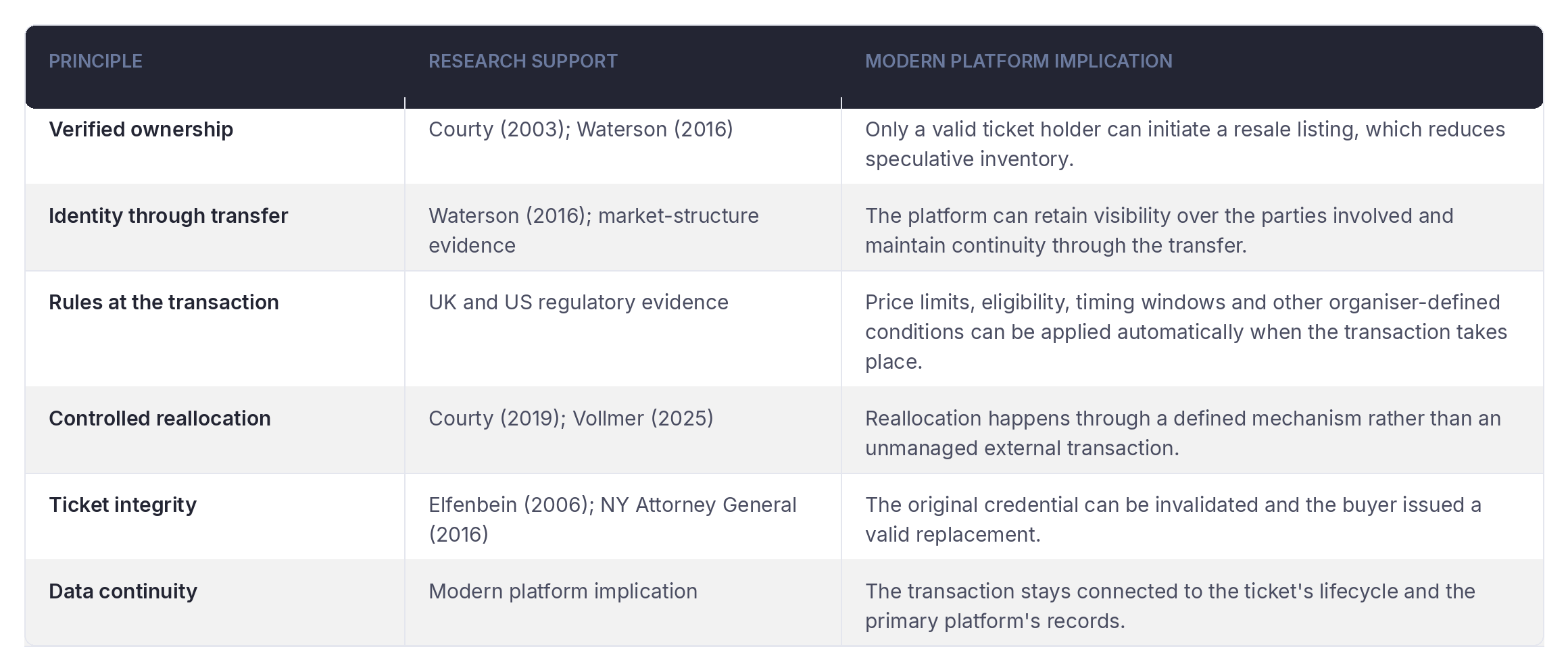
Not every principle here is proven by every paper. Some are directly supported by the research; others are this article's reading of what that research implies for a modern platform. Read together, they describe a design problem, not a single product.
What this means for ticketing platforms
Six conclusions follow from this body of research.
1. Resale is structural. Selling tickets in advance creates a period in which demand, availability and willingness to pay can change. Some form of reallocation is therefore likely to emerge whether or not the primary platform provides it.
2. Market design changes the outcome. The research does not support a simple resale-is-good or resale-is-bad conclusion. Pricing, scarcity, fees, transferability, market thickness and transaction costs all influence who captures the value resale creates.
3. Friction is a material part of the problem. Several studies identify meaningful costs around resale, including fees, queueing, rent-seeking, search costs and information problems. Reducing these frictions can materially change the outcome.
4. Primary revenue effects are context-dependent. The evidence is mixed. Resale can increase willingness to buy upfront in some settings, while other research finds limited or statistically insignificant effects on primary revenue. It should not be sold as guaranteed incremental revenue.
5. Enforcement mechanisms matter. Rules are harder to enforce when resale happens in channels outside a platform's direct reach. Transaction-level infrastructure creates a mechanism through which eligibility, price and transfer rules can be applied automatically.
6. Integration preserves more than the transaction. When resale remains connected to the primary platform, the ticket lifecycle, customer relationship, transaction data and transfer process can remain within the same ecosystem.
This is resale, done right. menta provides enterprise-grade, white-label, platform-native resale infrastructure for primary ticketing platforms: rules, payments, compliance, ticket transfer, operations and data, built into the primary experience rather than outsourced to an external marketplace.
Sources
Listed alphabetically by first author. Where a study was later published in peer review, the final published version is cited.
- Bennett, V., Seamans, R. and Zhu, F. (2015). "Cannibalization and Option Value Effects of Secondary Markets: Evidence from the US Concert Industry." Strategic Management Journal. DOI
- Budish, E. and Bhave, A. (2023). "Primary-Market Auctions for Event Tickets: Eliminating the Rents of 'Bob the Broker'?" American Economic Journal: Microeconomics, 15(1), 142 to 170. DOI
- Courty, P. (2003). "Some Economics of Ticket Resale." Journal of Economic Perspectives, 17(2), 85 to 97. DOI
- Courty, P. (2019). "Ticket Resale, Bots, and the Fair Price Ticketing Curse." Journal of Cultural Economics. DOI
- Courty, P. and Davey, L. (2019, published 2020). "The Impact of Variable Pricing, Dynamic Pricing, and Sponsored Secondary Markets in Major League Baseball." Journal of Sports Economics. DOI
- Cui, Y., Duenyas, I. and Sahin, O. (2014). "Should Event Organizers Prevent Resale of Tickets?" Management Science. DOI
- Elfenbein, D. (2006). "Do Anti-Ticket Scalping Laws Make a Difference Online? Evidence from Internet Sales of NFL Tickets." Working paper, Washington University in St. Louis. Link
- Leslie, P. and Sorensen, A. (2014). "Resale and Rent-Seeking: An Application to Ticket Markets." Review of Economic Studies, 81(1), 266 to 300. DOI
- Schneiderman, E. (2016). Prepared testimony and report on ticket bots. New York State Attorney General's Office. Link
- UK Government (2023). Response to the CMA's Secondary Ticketing Report. Department for Business and Trade. Link
- UK Government (2025). Response to the Consultation on the Resale of Live Events Tickets. Department for Business and Trade, and DCMS. Link
- The Digital Markets, Competition and Consumers Act 2024 (Commencement No. 2) Regulations 2025 (S.I. 2025/272). Link
- US Government Accountability Office (2018). Event Ticket Sales: Market Characteristics and Consumer Protection Issues. GAO-18-347. Link
- Vollmer, D. (2025). "Is Resale Needed in Markets with Refunds? Evidence from College Football Ticket Sales." RAND Journal of Economics, 56(3), 251 to 268. Originally circulated as US DOJ Antitrust Division Discussion Paper EAG 22-2, 2022. DOI
- Waterson, M. (2016). Independent Review of Consumer Protection Measures concerning Online Secondary Ticketing Facilities. UK Department for Business, Innovation and Skills. Link